
Register
Create the approved item record, identifier, category and storage reference.
Connected weapon, equipment and personnel records for authorised armouries, depots, warehouses and training facilities. Bring identification, custody, storage and maintenance into one accountable workflow.
For authorised institutions. Configured for your operation.
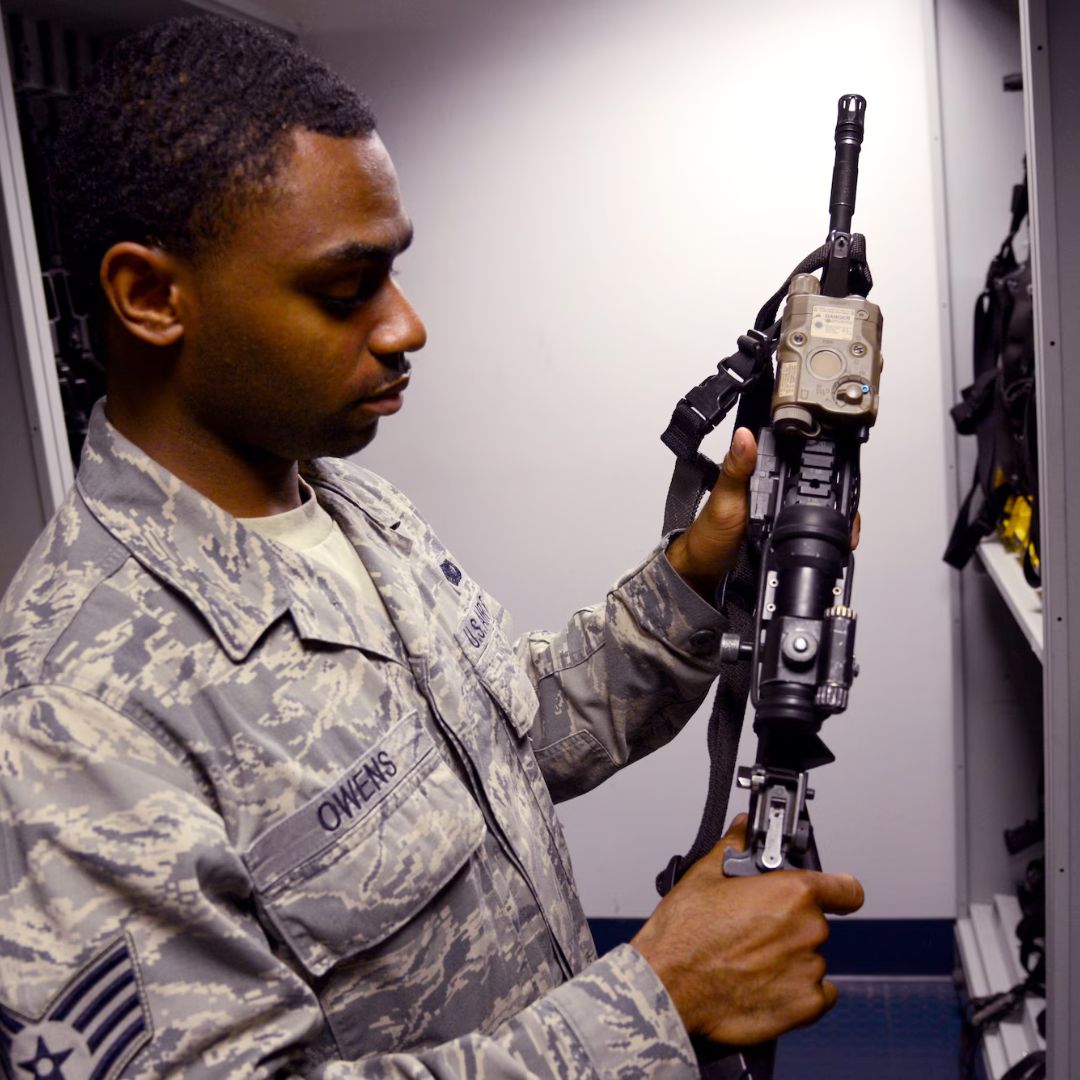
In military, law-enforcement, security and corrections environments, a missing item, unauthorised removal or incomplete maintenance record can have serious consequences. Reliable information connects each weapon, magazine, item of gear or ammunition record with its authorised custodian and storage location.
Our technology partner describes IoTWeaponTracker as an existing, ready-to-configure platform built on capabilities developed for prior clients. NTABTECH scopes the data, tracking methods, workflows, permissions and reports around your organisation. Software availability does not remove the need for site assessment, compatible hardware, installation and training.
Create the approved item record, identifier, category and storage reference.
Check the identified user’s permissions and applicable authorisation records.
Record the authorised assignment, transaction and custody acceptance.
Review supported detections or GPS/cellular events with defined access controls.
Record receipt, storage position and required inspection or maintenance status.
Compare expected and observed items, resolve exceptions and review the audit history.
Link each physical item to a unique database record. Barcode scans support deliberate transactions; compatible RFID readers can detect multiple tagged items at defined locations. Together, they support faster issue, return and reconciliation without treating every observation as continuous positioning.
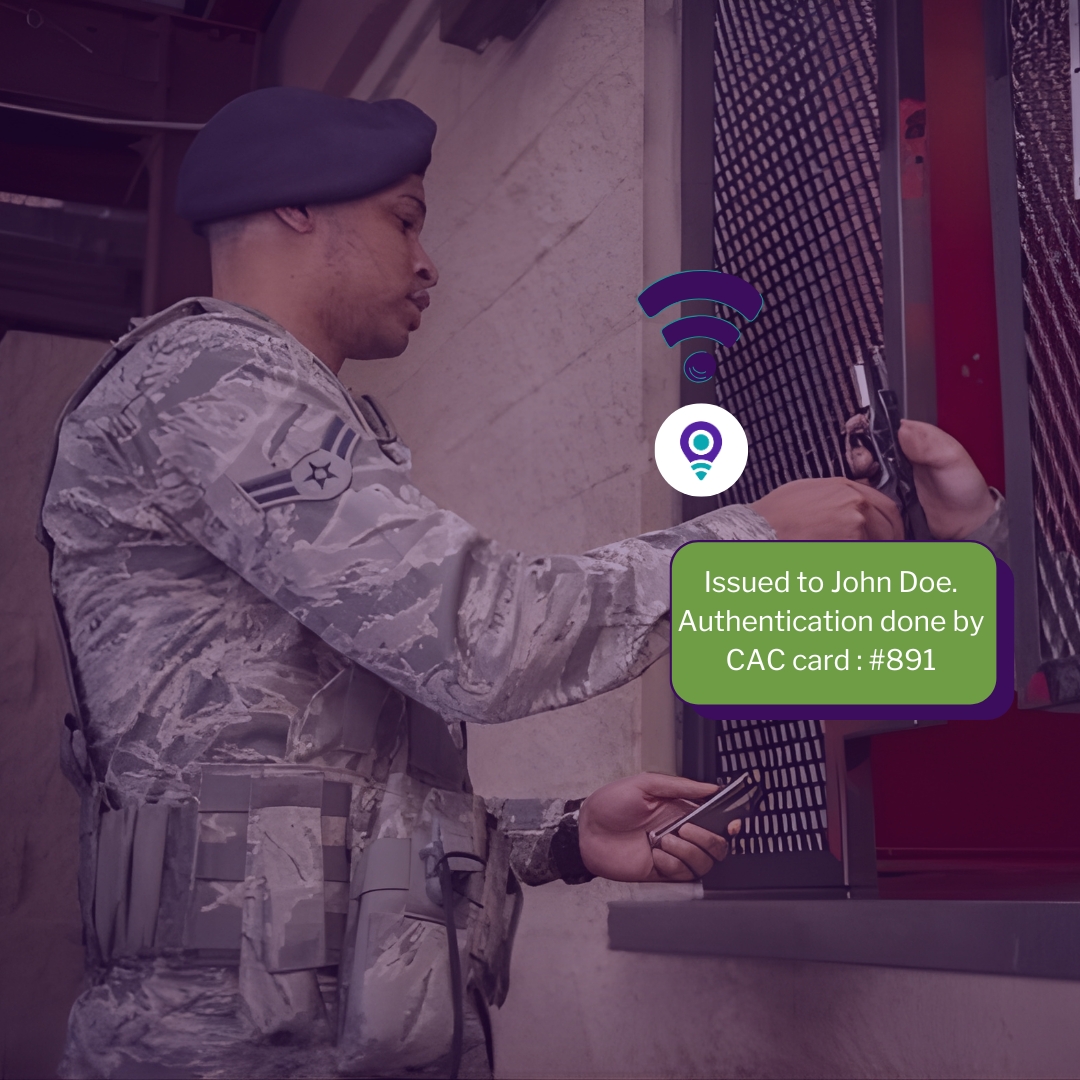
Record detections and transactions at issue counters, armoury doors, check-in desks and mobile audit stations. Review the item’s last recorded point alongside its assignment and custody history.
RFID readers and USB or mobile barcode scanners feed supported events into the software. User identity, time, location and transaction type form a reviewable audit record; exceptions still need staff attention.
Mobile scans compare observed items with expected stock, identify discrepancies and support documented handovers. Inventory speed and completeness depend on tags, readers, layout and reconciliation procedures.
Compatible powered weapon tags calculate position using GPS and transmit supported location and event data through cellular services. NTABTECH assesses device suitability, communications, power and authorised monitoring requirements before a configuration is proposed.
Generic illustrative GPS device model, not a weapon-tag product specification. Select a suitable tag with NTABTECH during assessment.
Supported tags send positions to the IoTWeaponTracker dashboard for authorised review and historical reporting. Update intervals, positioning quality and delivery depend on device settings, power and available network service.
Compatible sensors and software can support firing-event detection, geofence exceptions and configured inactivity rules. These are hardware- and configuration-dependent options, not universal features of every tag.
The partner describes BLE pairing between a compatible weapon tag and an authorised personnel card or key fob. A configured separation event can generate an alert; pairing, thresholds and delivery require validation.
The partner describes remotely disabling the tracking tag in an authorised configuration. This means the tag—not the firearm. It must not be interpreted as remotely immobilising a weapon or preventing its use.
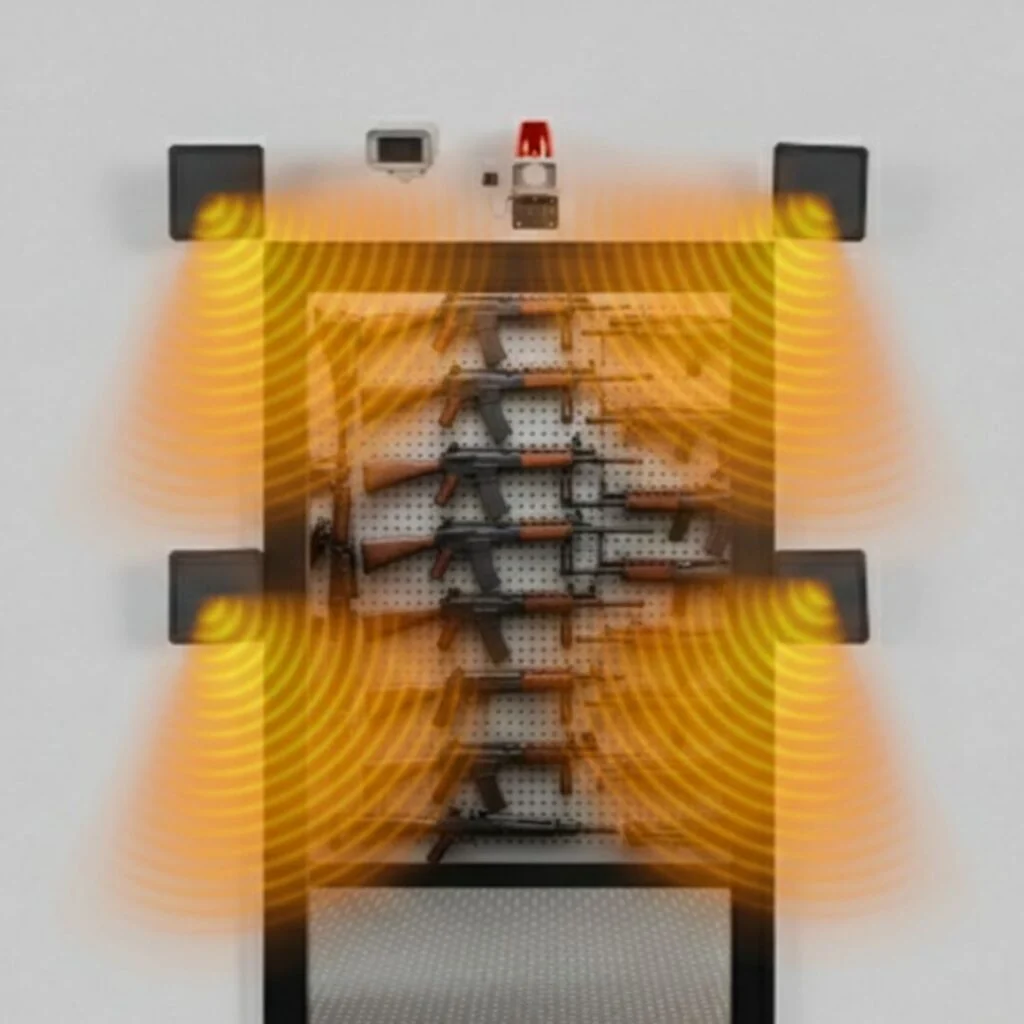
Combine suitable electronic racks, lockers or clamps with supported RFID monitoring and access-control workflows. Storage is configured around the item types, facility layout and authorised user roles, whether issue is supervised or approved self-service.
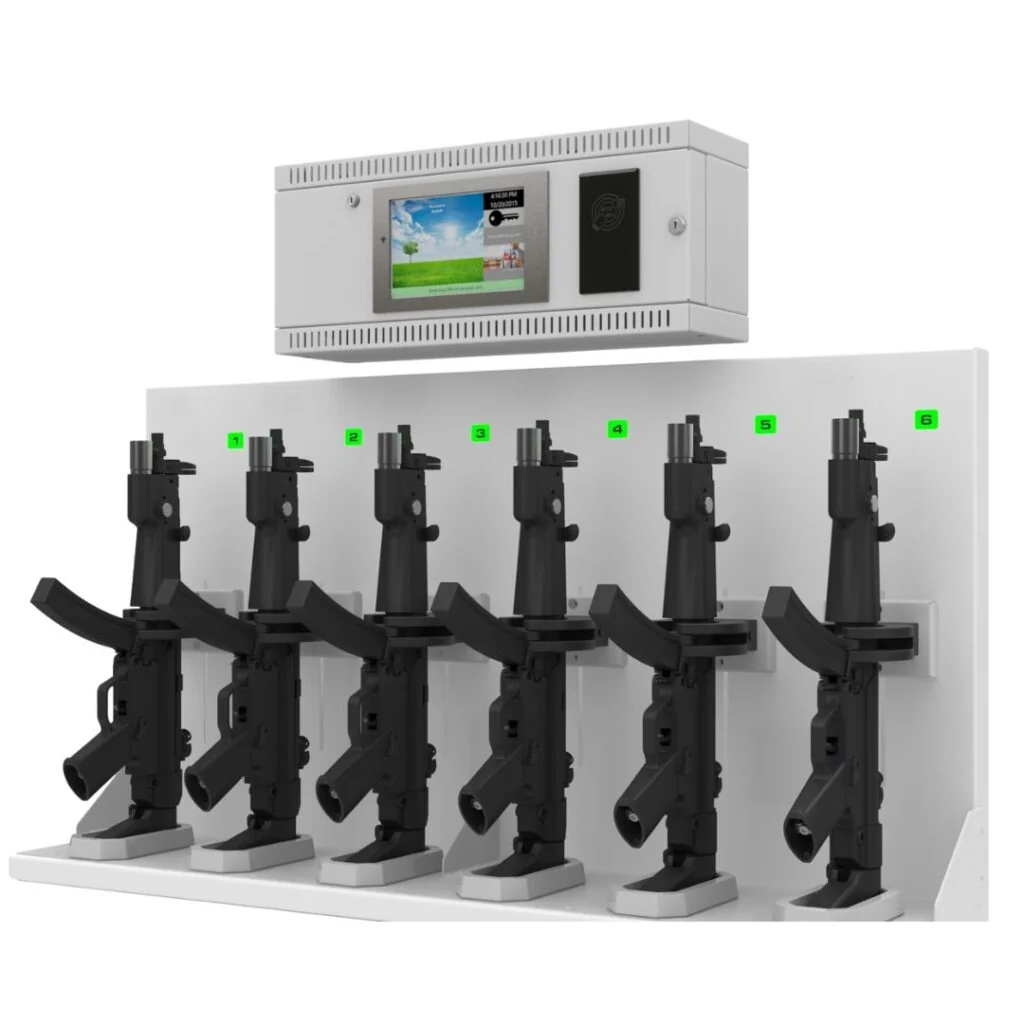
Depending on the selected equipment, fingerprint, PIN, ID card or supported smartphone authentication can identify the user. Permissions and applicable authorisation records determine which storage positions may be accessed.
Compatible storage can release the authorised compartment or clamp and use indicator lights to guide retrieval or return. Other positions remain subject to their configured access rules.
Built-in readers can detect tagged items leaving or returning to supported storage positions. Associate these events with the identified user and reconcile them with the central inventory and custody record.
Racks, sidearm lockers, longarm clamps and gear storage are assessed for fit and facility requirements. Compatible charging or weight-sensing options may be included after product validation; they do not replace required safety checks.
Select a sample storage asset and follow the authorised issue-and-return steps. The scene demonstrates records and workflow, not live tracking or weapon control.
Proposed asset-tracking workflows for armouries, equipment stores and evidence rooms connect item records with custody transfers, inspections and movement logs, using locally approved access controls and configurable reports, pending technical and site assessment by NTABTECH.
Defence and security organisations need dependable administrative records for equipment that changes hands, requires inspection or must remain traceable. NTABTECH proposes configurable asset registries and workflows using barcode or QR, RFID, BLE, WiFi, and—where infrastructure permits—GPS/GSM. Teams could record authorised custody transfers, inventory checks, maintenance events, inspection dates and supporting files, then review activity through role-appropriate reporting. Location may be last detected or live depending on the selected technology, readers, network and deployment design; it is not assumed to be continuous. The approach is intended for non-tactical accountability across armouries, stores, vehicles and evidence rooms. All sector deployments remain proposals pending technical assessment. Contact NTABTECH for commercial enquiries.
Proposed applications. Technology, coverage and workflows are validated through a technical assessment.
A proposed registry can associate tagged equipment with approved item records and authorised personnel roles. Barcode, QR or RFID workflows can support inventory checks and documented custody transfers, while permissions and reporting are configured for local policy. This is administrative accountability, not tactical guidance.
Stores teams can propose scheduled inspection, maintenance and calibration workflows for applicable equipment, recording status, dates, assigned work and supporting files. Barcode or RFID identification can help retrieve a record at a workstation or reader-equipped location; operational suitability requires assessment.
A controlled evidence register can be proposed to document item identifiers, intake, authorised transfers, storage references and audit events. Access, retention and export practices must follow the organisation’s legal and evidentiary procedures; the platform is not a substitute for chain-of-custody rules.
A shared asset registry can bring vehicle, office, industrial and heavy-equipment records into configured workflows for receiving, dispatch, audits and service events. GPS/GSM or other location options depend on suitability, coverage and infrastructure, with location representation defined during assessment.
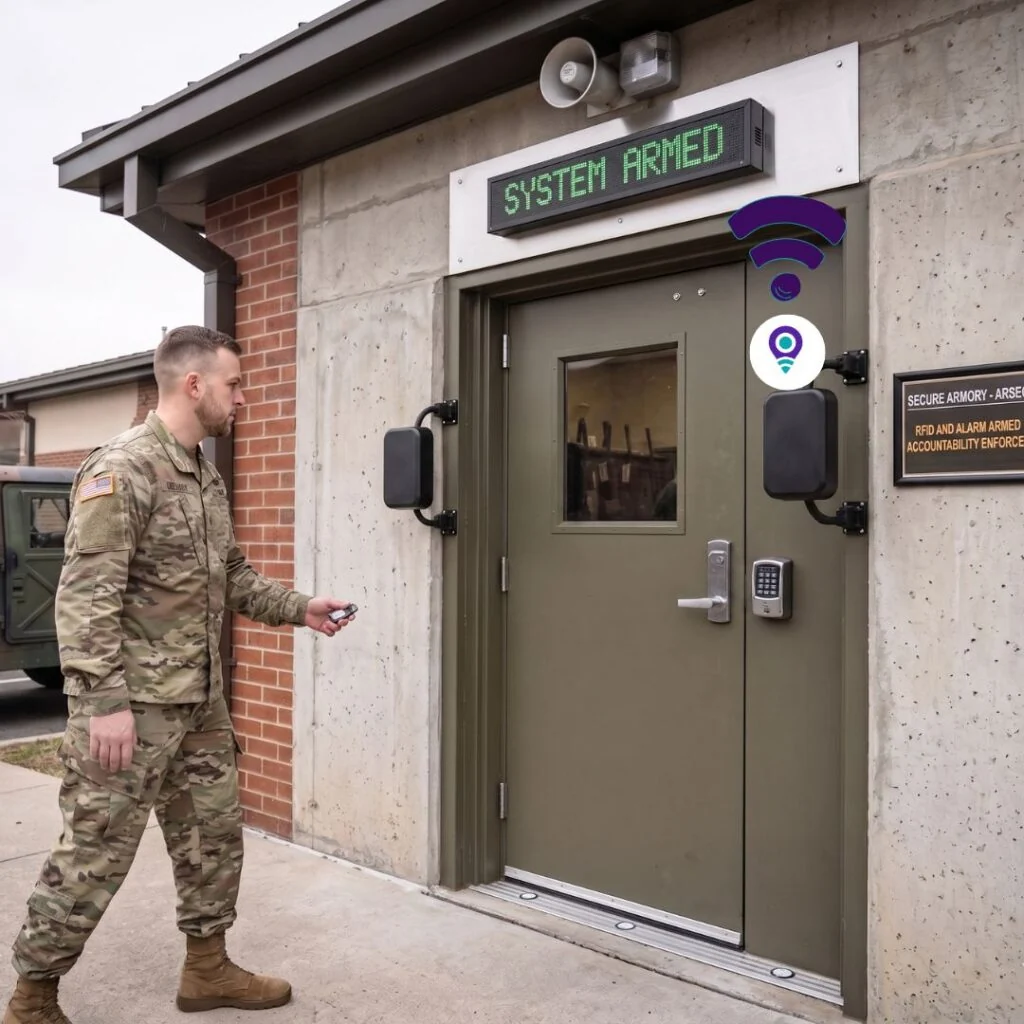
The partner portfolio includes administrative tracking of weapons, heavy weaponry and associated equipment. This showroom focuses on authorised inventory, custody, maintenance and audit records. Smart storage or outdoor GPS/GSM configuration must be assessed separately for the intended setting.
Bring item records, authorised handovers, inspections and supporting files into configurable workflows that teams can review and report against local procedures.
Select barcode, RFID, BLE, WiFi or GPS/GSM only after assessing assets, readers, connectivity, security requirements and operating conditions.
Configure access, evidence handling and reporting with consent, data minimisation, retention and accountable oversight built into deployment planning.
Sector deployments are proposed, not delivered. Assess assets, networks, security and legal requirements first. Passive RFID responds to powered readers; GPS determines position, cellular transports data only with coverage. Satellite links are unconfirmed. Personnel data requires consent, minimisation, access controls and retention limits. Commercial enquiries go to NTABTECH.
All visuals and records in this experience are illustrative. Location is a recorded detection or sample GPS event, not a guarantee of continuous live positioning.
Portfolio imagery helps explain the technologies behind a potential solution. The equipment, coverage and configuration for your own organisation are confirmed during project assessment.
Your assets. Your context. NTABTECH.Understand the technology before choosing a configuration.
No. Passive RFID identifies an item when it is read by a compatible powered reader. GPS/cellular tags are a different, powered technology. The selected system defines whether a location means a last detection, a zone observation or a transmitted GPS event.
No. The partner’s remote-disable feature refers to the tracking tag. NTABTECH does not present it as a firearm-disable or remote firing-control function.
No. These options require compatible sensors, paired BLE personnel devices where applicable, configured software, power and communications. NTABTECH confirms the supported feature set for the selected hardware.
The project can assess item registries, authorisation roles, current systems, storage layout, reporting and supported integration interfaces. An assessment confirms the practical scope before a pilot or quotation.
NTABTECH is your point of contact for requirements, demonstrations, quotations and pilot proposals. This website’s showroom uses illustrative records; it is not connected to a live weapons-management system.
Speak with NTABTECH about your armoury, equipment stores or controlled-property requirements. Start with a demonstration, a scoped pilot or a project discussion.
All demonstrations, quotations, pilot programmes and project discussions are coordinated through NTABTECH.
Device selection, legal requirements, secure access, retention, staffing procedures and site connectivity are agreed during technical assessment. This page describes partner portfolio capabilities, not completed NTABTECH installations. All showroom data is illustrative; no real alerting, firearm control or operational monitoring is provided here.
Privacy & authorised personnel safeguards
Start with your challenge. We’ll help shape the right tracking solution.